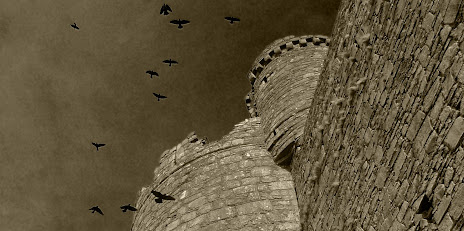
Rooks of Burgundy
Rooks of Burgundy is historical fiction set 1016/1017 in the Duchy of Burgundy. Raban is a young serf farmer in a small fief. Spring is freshly come and the world beginning again, and so the story opens.
Thursday, November 11, 2010
Wednesday, November 10, 2010
Tuesday, November 9, 2010
Thursday, September 23, 2010
Seven Comments
the snyders said...I enjoyed it! It drew me in and made me wanting to read more. I think the descriptions were well thought out, and it gave me a good idea of the time period. Looking forward to the final product!
While there is nothing specific in this comment, it does give me impressions, which is nice. And it made me feel warm and fuzzy inside, which is always a worthy endeavor. 7 Points
MLS said...
Look Fhgwhgads, I'm sorry to say I don't like it. Mainly because it's a long freaking opening. I mean in the time it took me to read it I could have done all kinds of stuff. Like paint a picture of a guy, with a big knife...whoa, in fact I'm gonna get started on that right away
Um...right. This one scores very low on coherence and helpfulness, but high on me recognizing the quote. As far as I know, most first pages are about a page long. However, you spelled fhqwgads wrong, so get -3 points and 7 points. Some may question the logic of this, to those I say...Trogdor the Burninator.
the snyders said...p.s. Mason love your music on here. He keeps dancing around and laughing at himself.
Irrelevant, but awesome. 11 points.
Courtney said...I ALMOST like it...a couple of things I would polish, which I will talk to you about when I'm not at work....I do like both of the "speech" pieces.
Anonymous said...The first paragraph is confusing. I didnt know if Raban was the strange knight riding on or if it was someone else. Need to establish that Raban is NOT the knight somehow.
Maybe put Raban on his old moldy horse in the first para and use it to juxtapose against the knight's hores. Use their differences as the basis for his unwarranted hatred of the knight.
"Haughty" and "lofty" are trite descriptions. Are there any warhorses that arent "lofty"? How do we know he is haughty if he hasnt done anything?
Raban's attitude is effecting what he sees. Somehow make it come from his perspective. -- Uncle David
MLS said...I see what he means about the first paragraph not making it clear that Raban is not the knight. Also, it needs to be clear whether Raban thinks the knight is haughty and lofty or whether the narrator is calling him that. I think that is what Uncle David means by making it come from Raban's perspective, because right now it is merely the narrator saying it. The same applies to the word "strange" in the first paragraph I think.
I do think it gave a good introduction to the time period and to Raban's position in society. I agree with Courtney that the dialogue is good.
MLS said...p.s. I left the comment above. Not that you would actually think that was Matt, but I meant to sign it. I have something to add anyway. I really like the third paragraph, and the whole rest of the passage actually. In my opinion, your only major problems are in the first two paragraphs. Of course that is no surprise. If openings are hard the openings of openings are the hardest. Carrie
Monday, September 20, 2010
First Page
Chapter One
“May the devil gnaw your bones,” Raban said under his breath. “And dredge out the marrow with his tongue.” The strange knight rode on, unaware of the disgust that he provoked.
Raban watched the haughty figure high upon its lofty warhorse. He did not know the man and yet he loathed him and all those like him. The armor and great helm glinted in the sun, giving a pompous warlike appearance. The shield was emblazoned with a passant bear, sable of color, with a dark green cross splayed on the polished steel. Two Squires rode behind, groomed perfectly as another piece of the man’s affectation.
Raban’s old workhorse strained at the harness, and Raban put all his strength into the plough. The earth crumbled free and they moved again. Raban cast a smoldering glance at the horsed figures. There was no respect in the look, as no doubt the knight assumed, but pure contempt. The three horses bore their riders out of sight and Raban fought the earth alone.
Another figure approached, on foot and whistling.
“What kept you, Orry?” called Raban, stopping his horse and smiling. “A pretty maid catch your eye and draw you off your course?”
Wednesday, September 15, 2010
First Draft Complete
Monday, September 13, 2010
120,000 words
Tuesday, August 24, 2010
110,000 Words
Friday, August 6, 2010
100,000 Words
Wednesday, July 21, 2010
90,000 words
Thursday, July 15, 2010
Mexico Journal Entries
Wednesday, June 9, 2010
Exerpt 3: Action
As they marched out of Nuon Raban’s mind was racing. They strode in single file and he was kept in the middle. All the while time Charlemagne kept pace with them, flitting from branch to branch, and Raban saw the men keeping a wary eye on the rook. The soldier in front of Raban was a gritty and degraded looking fellow, but more importantly, Raban saw he had a dagger at his belt, loose in the sheath. He edged as close as possible but could not reach it with his bound wrists. Every time he got his fingers near, it his feet tangled with the soldiers and there was a bout of curses.
In desperation he reached hastily forward, but just as he touched the handle, the man stopped dead still. Raban crashed into him and they tumbled to the ground in a tangle.
“Get off, maggot,” the soldier yelled, heaving Raban away. After bouncing roughly across the dirt, for his hands could not ease the fall, Raban scrambled to his feet and did his best to appear lowly. With a few more muttered curses, the man-at-arms got back in line and they all proceeded again. Raban glanced at the man behind him and then to the front. As subtle as he could, he began working the dagger into the rope between his wrists. It was difficult and awkward, and he was terrified of dropping the dagger, but he succeeded in cutting through the last thread of the rope. He hid the dagger up his sleeve and continued on. On they walked and he bided his time, waiting the opportune moment.
“What was that?” said Raban, jerking to a stop and peering off into the trees. “There’s a wolf or two in that stand of trees.”
“There never was a wolf around here in the daytime,” the captain said, but they all gazed into the thicket nonetheless. Raban crouched and snatched up a stone, dropped his bonds, and belted the nearest man over the head. Pulling out the dagger, he turned and wedged it into another’s thigh. Before the rest could see what happened or heed their fellow’s scream, he took off at a dead sprint. At a full run Raban ducked and dodged the branches and trunks. Vaguely, he heard the soldiers clamoring along behind. He looked back and saw a black shape streaking low through the branches. Charlemagne was keeping up with of him, executing his own maneuvers to dodge through the thicket trees while flying so fast.
But Raban had no time to think on his rook. One of the men was also keeping pace with him. They tore through the brush at full speed, the man unable to stop and string his bow or he would fall behind. Still they ran, neither gaining nor losing on the other. The rest of the company was left far behind and still they streaked through the wood, jumping logs and ducking branches. Something grabbed at Raban’s foot and he rolled in the moss. He was up again before he even slowed from his fall and bolted on. Then the archer was closer than he had been. After a moment more he was closer still, and Raban’s speed began to flag. Up ahead he saw Ragno’s hill, then Ragno himself sitting before his fire. Gasping for breath, Raban sped toward him and saw Ragno leap up, drawing a short sword. Raban tripped again and tumbled wildly. In the middle of his fall, as he as he stood on his head, he saw the archer leap into the clearing and Ragno strike him through the body. Raban finished his fall and a shriek froze the air as he slid to a halt. He rose to his knees and retched.
“Why so white? Haven’t you ever killed a man before?” Ragno was grinning at the dead man twitching gently at his feet.
Raban opened his mouth but found he could not say no and turned away without speaking. Charlemagne swooped down and landed heavily on Raban’s shoulder.
By the way, I just thought I'd mention that I'm open to any criticism anyone feels like giving. I'm not just here for the praise, you know. But I'm more interested in impressions that people receive when they read my stuff, not so much craft advice or things like, "You used the word 'on' twice in row". Though I wouldn't mind that kind of thing, I'm more interested in impressions right now.
Saturday, June 5, 2010
Excerpt 2: Dialogue
“We must capture some knights,” said Raban.
The bandits stared at him. “Pardon my hearing, but could you repeat that please?” Falk was wide eyed, something Raban had never seen before.
“We must capture some…”
“I heard you the first time,” Falk roared. “Have you gone mad? Did your stint in the dungeon loosen your brain?”
“We just rescued you at the expense of two of our friends,” said Cyr. “And the first thing you want us to do is go prancing back into Saint Bellamy and politely ask some knights to join us for a walk in the country.”
Raban absorbed the bitterness. Something inside him knew that he was to blame and he deserved whatever his men were bold enough to say.
“Since when is it well that we slur our leader?” said Odger.
“Since he proved unfit,” Emmeran mumbled, just loud enough to be heard.
“Fool,” Odger growled. “Raban has always led us well, to be sure. And to betray him is to betray Bero, for he is the chosen replacement.”
“Bero did not act foolishly and get his men killed,” Martin said, then silenced himself and glanced at Raban, a soundless apology.
“Neither has Raban,” Turpin said quietly. “Even if we were all here we cannot know that we would have escaped. Perhaps the man on watch would have been killed by stealth. We know they had large numbers. They may have taken us in a charge. We will not know what would have happened, so it is fruitless to lay blame. Raban acted foolishly, no doubt. But perchance he acted foolishly and saved eleven of his men, rather than killed two.”
They were silent, thinking on what Turpin had said. Raban loathed being talked about as though he was not there, but he knew he must let his men speak their minds.
“May I ask a query?” said Walaric, clearly uncomfortable joining in the dispute.
Raban nodded.
“Why are we to capture a number of knights?”
“I’m pleased you have asked,” Raban smiled. “To judge them.”
“You’re not serious,” Emmeran sulked. “You still think you are God’s own sheriff?”
Raban thought a moment. “You know, I believe you’ve put words to it nicely.”
All were silent for a moment, then Falk let out a bitter chuckle. “It’s only fair for God to have a finger in the world. The devil’s got enough.”
“When I was in The Court,” said Allowin, “we played a game with little figures on a board to imitate battle. Now, the lucifer may have more pieces left, but our father in heaven has the better strategy, that’s sure.”
“So…we are the pieces,” Walaric was puzzled.
Raban smiled. He had seen the game that Allowin spoke of. Though most the others did not follow their friend, Raban understood.
“How are you planning on capturing these blessed knights?” asked Cyr, returning to the matter.
“On a hunt,” said Raban. Charlemagne beat his wings and screamed. The sound echoed through the forest, glancing off trunks and darting through the laden limbs. A bough released its load nearby and the cascade of snow struck the ground with a muffled thud. The high wavering cry ebbed away slowly.
“That bird is going be our deaths,” growled Falk. “If not from giving us away, then giving us fits.”
Raban exhaled, realizing that he had been holding his breath.
“Do you really think that they will continue the hunts in this bitter cold?” Turpin asked.
“Yes,” Allowin interrupted. “In a castle full of knights someone will always find sometime to hunt something, even if it is only the serfs’ livestock or the street curs.”
This is bordering on giving too much away, and it pains me to post it. But knowing the traffic on this blog, I'm not too worried. If three people in the world have a little spoiler I can live with that.
Thursday, June 3, 2010
Excerpt
Dusk approached and the light splashed longways through the trees, igniting the leaves and turning the forest to flame. Raban watched as the light changed in hue and angle. He felt as though he was walking amid the sunset. A lone needle tree caught his eye, for it remained dark and solemn even in the blaze around it. It looked as though it might provide some shelter and he approached to see better in the strange light. A slight color variation in the tree’s branches caught his eye and he halted. Grass and rope had been weaved into the branches of the huge pine tree, binding them together tightly. Pitch had then been slathered over all to seal out the weather. The lower branches brushed the forest floor, forming what looked like an upside down basket.
Raban backed quickly away into the woods and he circled the strange tree, looking for an entrance. A brown cloth hung from inside the basket, covering a small gap in the limbs. Raban settled where he could keep watch on it. It would be foolish to approach this tree, he knew. Any kind of man could live out here, a kindly hermit as easily as a blood mongering bandit. Raban was almost sure no one was inside, but he would wait first to find out.
Darkness fell completely and ears were more use than eyes on moonless nights such as this. Raban lay down and wrapped himself in his blanket. Nothing stirred for hours and he felt the weight of fatigue press down upon him. His eyelids closed even as he tried to hold them open. The thick moss, despite its dampness, provided none too uncomfortable a bed and Raban fell asleep on his vigil.
Well, there it is. Not the best snippet, I realize, but hey, it's something. I'll post another soon. Maybe something a bit more...exciting.
Tuesday, May 18, 2010
First Chapter
Monday, May 10, 2010
80,000 words
Monday, April 26, 2010
Blog Music
Wednesday, April 14, 2010
Hi
It was quiet as I climbed to the top of the little hill. I walked through the trees that covered the slope, their spreading branches sheltering the hill from the sun, creating a dimmed gray and green world under the canopy. Their was no sound save the essential forest noises; the shuffling of leaves, the rustling of squirrels and chipmunks, perhaps the beating tiny wings as bird traverses from tree to tree. All the sounds my brain filters out unless I remember to listen. Who knows how many thousands of years it had been like that on the hillside, silent and slow. The forest is always doing something; growing, eating, reproducing, and dying, yet nothing ever happens at fast. The forest takes its time going about its business, even if some of its dwellers are more impatient. Yet after all the years of its steady life, the slow molding of the hill by time, it is famous for one day. The antithesis of silent, the antithesis of slow. This hill, called Little Round Top, is famous for
I reached the summit and emerged from the cover of the trees. It was nearly bare on top, and a small rim of rock three feet high stood along one edge of the hill. It was as though a war god had built it specifically for the union soldiers to crouch behind, but it only served this purpose for one day, and for the rest of its millennia, it just was. I leaned against the stone barrier and looked down the slope to Devil’s Den. The jumbled pile of huge rocks and boulders looked strange at the base of the hill. Trees grew on and in between the rocks, giving it a wild look. I imagined confederate soldiers swarming through the rocks while the union soldiers crouched beside me poured down lead from Little Round Top. I could barely see the boulders for the powder smoke. The little stream that ran beside Devil’s Den flowed and babbled pleasantly. It was as amiable as any other stream, and ran much as other streams run for longer than anyone knows. But it is famous, or infamous, for day its water turned red.
I turned and made my way to the other side of the hill. Moss and lichen splotched the stone underfoot, for nothing else could grow on the bare summit. I dropped down into the woods and looked down the slope. It wasn’t so steep here, and was lightly wooded. I stood exactly where the 20th
A chipmunk sat on a log twenty feet away. It twitched and jerked as it went about its business. It grabbed indistinguishable objects from the log and devoured them, keeping a wary eye on me. I wondered if it had an ancestor, countless generations back, that had been there that day, minding its business the same as the one before me, when suddenly, some kind of hell broke loose. Humans in grey, screaming their terrible scream, flooded up the hill toward the chipmunk. Humans in blue kneeled in a row and unleashed thunder and lightening. The Chipmunk sprinted for safety as unseen objects buzzed through the air, tearing limbs from trees and ripping shrubs to pulp. Perhaps the animals that survived the cross-fire told stories of the day the humans went berserk. Maybe they warned their children that when the human’s line up in rows, they had better get out of there. I pictured them sitting around planning what they would do next time. Some of the birds even made up a special berserk human warning call. But they never got to use it, for it would never happen again. I looked at the chipmunk and laughed at myself. My imagination was even more vivid than usual. I blamed the stillness of the woods.
Nothing around me gave any hint of what had happened, except a sprinkling of small monuments and plaques. Nature had healed itself, scarless like a clean slice. It must have taken it quite some time, but it fixed itself eventually. The one day that it chanced to be witness to the human conflict that sullied its natural state, it acquired infamy. While the events that happened where I was standing are some of the most well known of the American Civil War, the hill and the trees shaped them, caused them to play out as they did. The Confederates had to take the hill. The
Not even a day, ninety minutes. The 15th
The Chipmunk let out a series of loud squeaks then went silent. I looked around and saw that the woods were the same as any other hillside. I remembered to listen again and heard the leaves shuffle, and unseen creatures rustling on the forest floor. A tree near me groaned and popped as it leaned in the wind. It leaned back and snapped again. It sounded like musket fire. Or maybe my imagination was taking creative liberties again. The Chipmunk scampered up a tree and I began my descent down Little Round Top.